



Portrait of the Artist
Who I am as an artist, and my history.
I was told once in an art class that I wasn’t very observant. Not a good beginning for someone who wanted to be an artist. We think of artists as keen observers of nature and the material world around us. We expect artists to have some innate ability to draw and a sharp observation of the world. For me, drawing wasn’t the problem. I just couldn’t draw a spoon from memory and I didn’t know how the shape of a hammer loop on the back of workmen’s trousers. Why I should know this is a mystery, but it seems this was the acid test of my ability to be observant. I could draw if something were placed in front of me, but for the life of me I couldn’t draw from memory. I just didn’t know how things went. I began to wonder if in fact being an artist was the right choice for someone who was so unobservant.
Art School
Anyway, I went to art school in the early 1970s, and there I was told I was more of a technician rather than an artist. This was because I could draw something sitting in front of me, but was very bad on imagination – coming up with designs, compositions, shapes, and themes on my own. Not very promising.
However, my own struggles outside of art school found me trying to make shapes that conveyed some kind of feeling. My first attempts were pretty sentimental, but I did notice that I wasn’t trying to copy nature or reinterpret nature in an original way, which is often what art students did at that time. I didn’t work from still life arrangements, landscapes, or portraits. I could make these kinds of images, but I preferred to push material around until it assumed some kind of satisfying shape that gave me an inner feeling of upliftment or tranquility. I also discovered at this time that three dimensional shapes rather than painting or drawing gave me the kind of experience I was after.
Carl Jung
Around the same time as I was starting to explore the emotional impact of three dimensional shapes and lines, a good friend introduced me to Carl Jung, the psychologist. Reading Jung was like discovering truths I had always known but had forgotten. From Jung I learned that there were two basic personality orientations, the extrovert and the introvert, and within those two groups were at least four basic types: thinking, feeling, sensation, and intuition. According to Jung, each of us favours one orientation over the other; that is, we are either introverted or extroverted, to varying degrees. In addition to that orientation, each of us has a dominant personality type, with the other types being less dominant, with the least dominant classified as inferior.
More About Joan
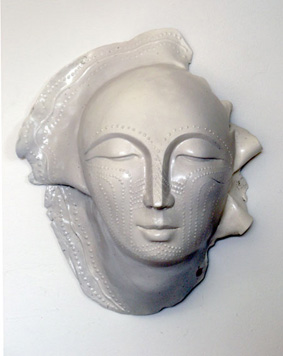
Musing
ceramic wall sculpture
sold
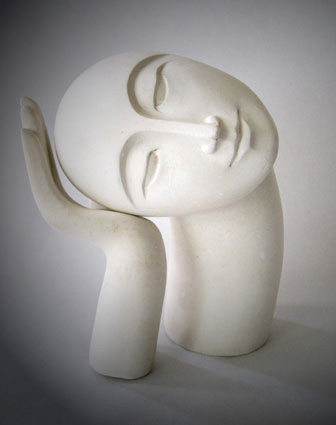
Metis
plaster maquette
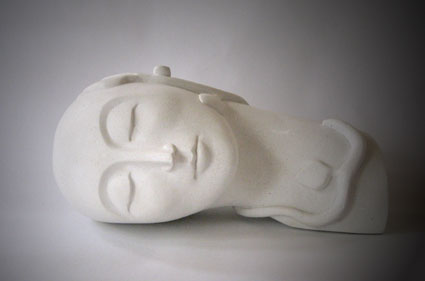
Pythia Dreaming
ceramic
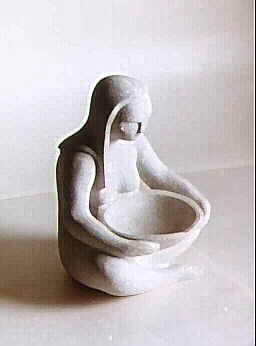
Birdbath
concrete maquette
Jung discovered that people who favour thinking as a way of understanding the world, often have the opposite type, feeling, as an inferior function; that is, their feeling side of their nature is less developed and they trust it less to arrive at an accurate understanding of the world. People who have highly developed sensation are the keen observers. Hence, I concluded that I was not very good on sensation, but that my thinking function perhaps was my dominant one. I subsequently discovered that I trusted my feelings far more than thinking, hence my preoccupation with trying to convey feeling through shape. Also, my basic orientation was introversion; hence I was more interested in what went on inside the mind than in the external world. Jung helped me to understand the kind of artist I could be. Not a plein air painter nor a portrait artist, but an artist who creates forms from an inner experience of the world rather than from an external observation of the world.
Art and Personality
We weren’t taught any of this at art school, that is, that there are different ways of being an artist and each way is based on one’s personality. The extroverted sensation type will tend towards an exploration of the external visual world, perhaps through landscape or portrait painting. Should an extrovert choose purely abstract work, the emphasis would probably be on the visual impact of arrangements of colour, shape, and design. The introverted feeling type may use the same visual material from the external world – images from nature, human form, faces, etc. – but will use these images to conjure up feelings and images from the imagination and inner world. It is into this category that I place my work.
Archetypal Imagery
The faces in my work are not of individual people. Rather, they are what Jung called archetypal – the basic form before individual personality arises. Hence the faces I create are not of anyone in particular, but of an elemental or archetypal feeling of femaleness. I think it’s fairly obvious that I am using these female images and the colours, shapes, and lines, to convey a variety of feelings or inner experiences rather than likenesses. Some of them are overtly mystical. In others, I try to convey a variety of feelings ranging from tranquility to shadowy moodiness and mystery.
Techniques
I won’t say anymore about my work. I’ll let it speak for itself, hopefully successfully. I will just add that the images in the paintings are photographs taken from sculptures I have created. I have printed these photographs onto rice paper, and using traditional Chinese and Japanese brush painting techniques, have embellished the photographs to create a mood. The ceramic works similarly draw on more three dimensional sculptures of mine. I have taken molds from the faces and pressed clay into the molds to create a surface I can embellish with brush painting, sprayed oxides, and glazes.